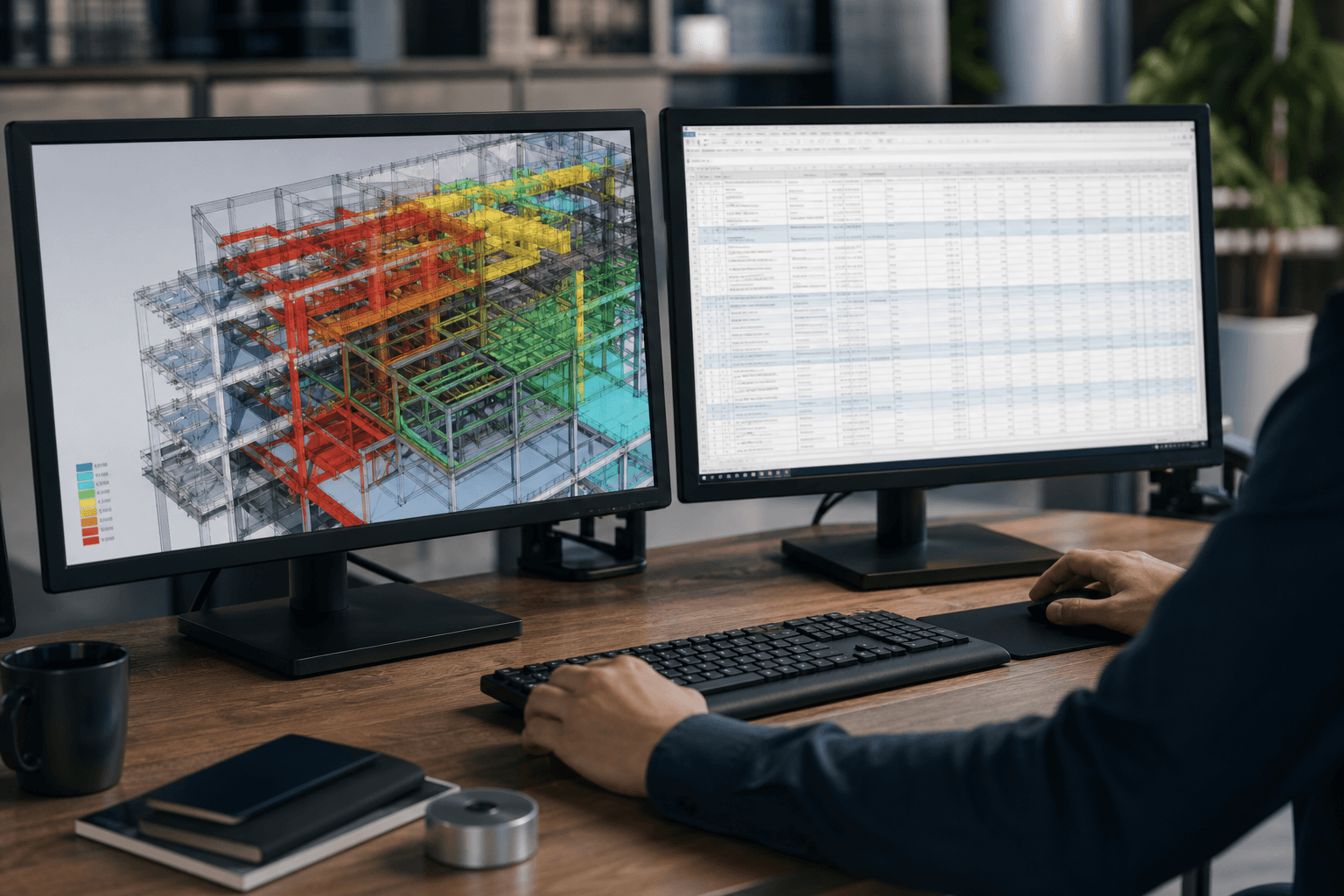
In today's fast-paced construction industry, efficiency and accuracy in project execution are paramount. Manual measurement methods, traditionally utilized for quantity takeoff, are both time-consuming and prone to human error. This is where Building Information Modelling (BIM) comes into play, offering transformative tools that significantly streamline these processes. At Adyantrix, we have pioneered the adoption of BIM technology to automate quantity takeoff, reducing manual measurement time by an impressive 60%.
Understanding Quantity Takeoff in Construction
Quantity takeoff is the backbone of any construction project. It involves calculating the total volume and cost of materials required for a structure. Traditionally, this has been a labor-intensive task, requiring skilled personnel meticulously combing through blueprints. However, with the advent of BIM and its integration into constructions processes, this narrative is changing rapidly. BIM facilitates the real-time calculation of quantities directly from the digital model, ensuring higher accuracy and reducing inconsistencies often found in manual measurements.
Adyantrix's integration of BIM in quantity takeoff processes allows teams to access data dynamically, resulting in fewer discrepancies. McGraw Hill Construction reports that companies utilizing BIM have seen an average reduction in change orders by 40%, underscoring the importance of accurate initial estimates.
This accuracy gain compounds when quantity takeoff is treated as the foundation of a broader digital estimating workflow rather than an isolated task. When quantities extracted from the model feed directly into 5D cost estimation, teams gain a live, model-linked view of budget exposure rather than a static snapshot frozen at tender stage. We explore this connection in more depth in our post on 5D BIM cost estimation and accurate quantities, which looks at how quantity data flows through to scheduling and pricing.
The Role of BIM Tools in Automation
BIM technology innovatively interacts with software to automate quantity takeoffs. Tools like Autodesk's Revit and Navisworks enable seamless integration and data extraction directly from digital models. Adyantrix leverages these tools to automate processes that were once manual, freeing up valuable time for project teams.
For instance, consider a project where detailed steel reinforcement is required. Using traditional methods, calculating such quantities could take days. However, with a BIM framework, precise calculations can be obtained within hours as the software pulls data directly from the 3D BIM models. This process not only speeds up quantity takeoff but also provides more reliable data that can be easily updated as design changes.
To illustrate, let’s look at the Revit platform utilization:
# Sample code snippet to illustrate basic Revit API automation
from revit import DB

# Opening a model and extracting wall quantities
model_path = "C:/Path/to/Revit/Model.rvt"
document = DB.Document.Open(model_path)
walls = DB.FilteredElementCollector(document).OfCategory('OST_Walls')

# Summing up wall areas
total_wall_area = sum([wall.get_Parameter(DB.BuiltInParameter.HOST_AREA_COMPUTED).AsDouble() for wall in walls])
print("Total Wall Area:", total_wall_area)
This simple script extracts and calculates total wall areas from a Revit model, highlighting how BIM not only reduces manual work but also enhances data availability in real-time.
Beyond Revit and Navisworks, many teams layer in dedicated quantity takeoff plugins and estimating platforms that read directly from the BIM model's parameter sets, allowing quantities to be filtered by material, level, or work package without manual re-sorting. This modularity is particularly valuable on multi-discipline projects, where architectural, structural, and MEP quantities must be reconciled against a single shared model rather than three disconnected spreadsheets. Adyantrix configures these extraction pipelines during the BIM execution planning phase, so that the parameter structure supporting quantity takeoff is agreed upon before modelling begins rather than retrofitted afterward.
Integrating Quantity Data with Cost and ERP Systems
Automated quantity takeoff delivers its fullest value when the data it produces does not stop at the estimating desk. Once quantities are extracted reliably from the model, the next logical step is connecting them to the cost codes and financial systems that govern how a project is actually budgeted, tracked, and paid for. Without this link, teams often end up manually re-keying quantities into ERP or accounting software, reintroducing the very transcription errors that BIM was meant to eliminate.
Adyantrix builds structured mapping layers that tie BIM element parameters directly to cost codes used in systems such as SAP, ensuring that a change in the model automatically ripples through to the relevant budget line rather than requiring a separate reconciliation pass. Our detailed walkthrough on linking BIM to ERP and mapping cost codes between Revit and SAP covers the practical steps involved, including how to structure shared parameters, handle unit conversions, and validate that quantities reconcile correctly across both systems before a project moves into construction.
This integration also supports better forecasting. Because quantities update as the design matures, cost forecasts derived from them become progressively more accurate rather than being re-estimated from scratch at each project gate. Finance teams gain visibility into committed and forecast costs earlier, and site teams gain a single source of truth for how much material has actually been ordered versus what the model anticipates will be needed. For organisations managing multiple concurrent projects, this consistency is often what separates a BIM investment that pays for itself from one that stalls after the pilot phase.
Common Implementation Challenges and How to Address Them
Adopting automated quantity takeoff is rarely a matter of simply installing new software; it typically requires changes to modelling discipline, team training, and quality assurance processes. One of the most frequent obstacles is inconsistent modelling practice across disciplines. If structural engineers and architects use different naming conventions or parameter structures for similar elements, automated extraction rules can misclassify or miss quantities entirely, undermining confidence in the output.
Adyantrix addresses this by establishing a BIM execution plan that standardises parameter naming, level of development, and classification systems before modelling begins, so that quantity takeoff rules can be written once and applied consistently across the project lifecycle. A second common challenge is validating automated outputs against known benchmarks during the transition period. Teams moving away from manual takeoff understandably want assurance that the automated numbers are trustworthy, so Adyantrix typically runs a parallel validation phase on early work packages, comparing automated quantities against traditional manual counts until confidence in the model-derived figures is established.
Training is the third major factor. Quantity surveyors and estimators accustomed to manual measurement need structured onboarding to interpret model-derived data correctly, understand how design changes propagate through quantities, and know when to flag anomalies rather than accept automated outputs uncritically. Adyantrix supports this transition with hands-on training sessions and documented workflows, ensuring that automation augments the judgement of experienced quantity surveyors rather than sidelining it. Addressing these three areas early, modelling standards, validation, and training, is consistently what determines whether an automated takeoff rollout succeeds across an entire portfolio or remains confined to a single pilot project.
Benefits of Automated Quantity Takeoff
Reducing manual effort is just one of the many advantages of BIM-based quantity takeoff. By automating these processes, Adyantrix clients benefit from enhanced accuracy and decreased project timelines. The integration of automated quantity takeoff also leads to better resource management and cost savings.
Additionally, automation facilitates faster response to project changes. Should there be design alterations, the revised quantities are recalculated instantly, allowing for real-time collaboration across stakeholders. These benefits create a stronger alignment between project intention and reality, minimising costly delays and miscommunications.
Comparing Traditional and BIM-Based Quantity Takeoff
To understand the profound impact of BIM on quantity takeoff, let’s compare traditional manual methods with BIM automation:
| Aspect | Traditional Methods | BIM Automation |
|---|---|---|
| Time Consumption | High, due to manual calculations | Low, due to automated calculations |
| Error Margin | Moderate to high | Significantly low due to precision |
| Resource Intensity | Requires large teams | Requires fewer, more skilled personnel |
| Adaptability to Change | Slow and cumbersome | Fast and efficient |
| Cost Implication | Higher due to inefficiencies | Lower due to optimised processes |
In this table, it’s apparent that BIM not only enhances efficiency but also brings down project costs, a feat that Adyantrix achieves through skilled implementation and management.
Real-World Applications and Case Studies
Project success stories manifest the efficacy of BIM-enabled quantity takeoff. A notable project managed by Adyantrix involved a large commercial complex where BIM reduced the quantity takeoff time from six weeks to under three days. As reported by Construction Dive, similar projects adopting BIM have seen a 20-30% increase in productivity, further validating claims of its transformative impact.
Through such real-world applications, Adyantrix continues to circumvent conventional inefficiencies, delivering projects that remain within budget and timeframes, ultimately enhancing client satisfaction.
Frequently Asked Questions
Quantity takeoff in BIM involves extracting data directly from 3D models to calculate the required quantities of materials, thus enhancing accuracy and reducing the reliance on manual drafting and checks.
BIM improves quantity takeoff by automating data extraction and calculation processes, providing real-time updates and reducing the potential for human error, thereby speeding up project timelines.
Choosing BIM over traditional methods offers increased accuracy, decreased manual workload, better cost management, and agility in adapting to design changes without extensive delay.
Yes, virtually all types of construction projects, whether small or large, can benefit from the efficiency and accuracy improvements provided by BIM-based quantity takeoff processes.
Adyantrix is at the forefront of integrating BIM technologies, offering consultancy and tailored solutions to clients, ensuring seamless automation of quantity takeoff processes suitable for diverse project requirements.
Conclusion
Harnessing the capabilities of BIM for quantity takeoff automation can drastically transform how construction projects are executed. Adyantrix stands as a leader in this arena, ensuring projects benefit from reduced measurement times, increased accuracy, and overall cost efficiencies. If you're looking to revolutionise your project processes through technology, explore our BIM Automation services and see how we can aid in propelling your projects towards successful completion.