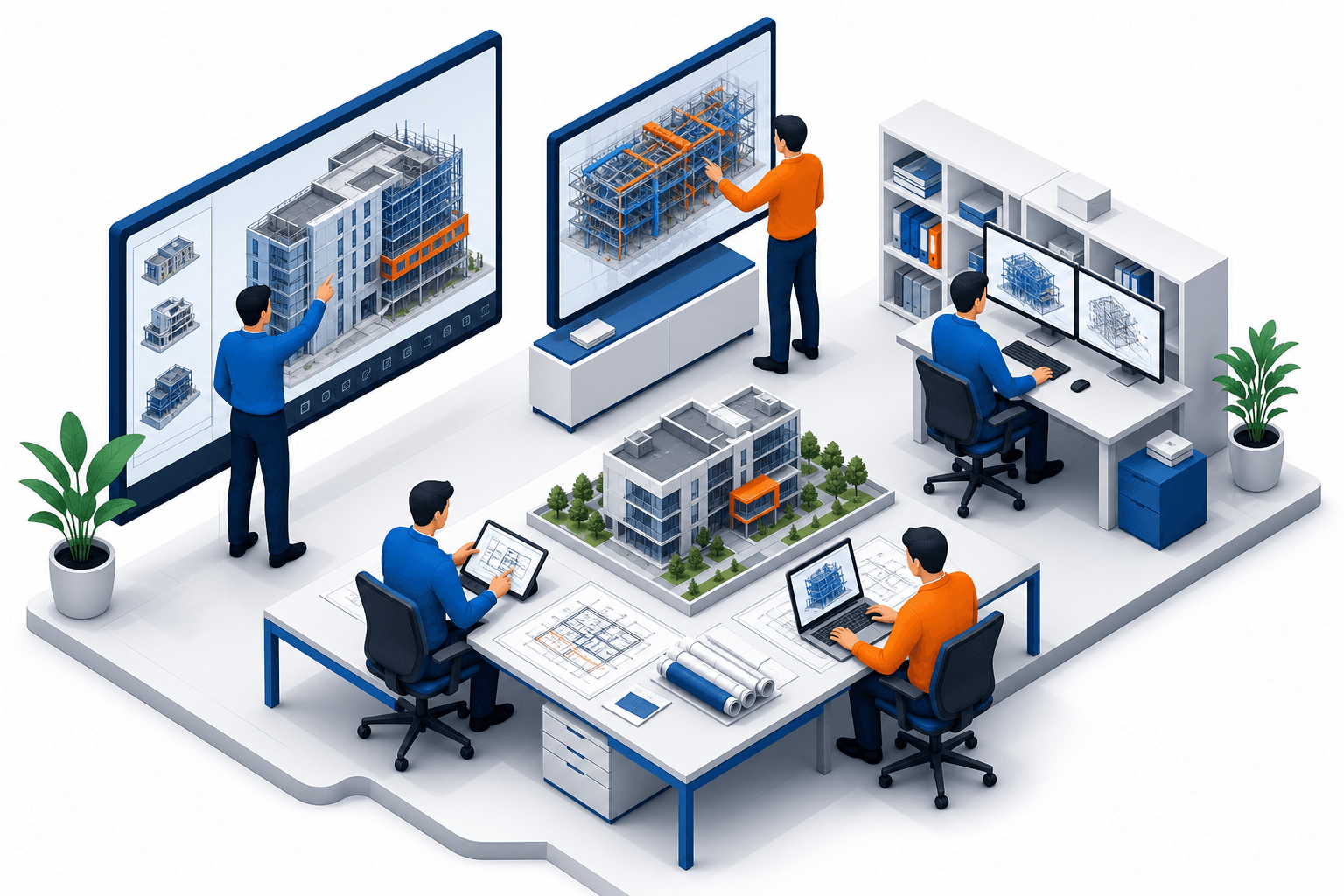
In today's rapidly evolving construction and real estate industry, Asset Information Models (AIMs) have emerged as a cornerstone for fostering smart building operations. AIMs serve as comprehensive digital repositories of all information related to a building's assets, and they play a crucial role in the optimisation of facility management and the lifecycle of buildings. Adyantrix, with its extensive experience and expertise in BIM services, recognises the value that AIMs bring to simplifying the complexities of modern building operations.
As portfolios grow larger and more distributed, facility teams are under mounting pressure to do more with fewer resources while still meeting sustainability targets and occupant expectations. An AIM addresses this pressure directly by consolidating fragmented spreadsheets, PDF manuals, and disconnected building management system (BMS) exports into a single, structured, queryable source of truth. Rather than treating information as a by-product of design and construction, an AIM treats it as a strategic asset in its own right, one that continues to generate value for decades after handover. This shift in mindset, from documentation to data-driven operations, is what ultimately separates a building that merely functions from one that performs — a theme we explore further in our post on digital twins for live asset intelligence.
The Role of Asset Information Models in Smart Building Operations
Asset Information Models are integral to the smart management of building operations. By compiling comprehensive data about all building elements, AIMs help in ensuring efficient and economical operations throughout the building's lifecycle. They encapsulate data on HVAC systems, electrical setups, structural components, and more, promoting an intelligent approach to facilities management.
Real-world applications showcase impressive results. For instance, consider the efficiency gains in the operation of educational campuses, where AIMs have been deployed to manage complex facilities effectively, minimising maintenance costs and improving occupier comfort. According to a report by the National Institute of Standards and Technology, facilities employing advanced information modelling technologies witnessed a 30% reduction in operational inefficiencies.
Adyantrix utilises AIMs to bridge the gap between design and operations, ensuring that building managers have access to reliable and up-to-date information that aids in optimal decision-making. This not only streamlines workflows but also enhances the sustainability and functionality of a building.
Beyond maintenance scheduling, AIMs give facility managers a single point of reference for space utilisation, asset warranties, compliance certificates, and health and safety documentation. When a fire safety inspector or an environmental auditor requests evidence of a system's service history, the answer is a query away rather than a search through filing cabinets or shared drives. This level of traceability is increasingly important as regulatory frameworks around building safety, such as the UK's Building Safety Act, place a stronger emphasis on the "golden thread" of information that must follow a building throughout its life. An AIM is, in effect, the practical mechanism through which that golden thread is created, maintained, and handed over between stakeholders.
BIM and Asset Information Models: A Synergistic Approach
Building Information Modelling (BIM) and Asset Information Models are often used in tandem to unlock a building's full potential. While BIM focuses on the construction and design phase, AIMs extend their utility to the operational phase, ensuring that buildings remain functional and efficient long after construction.
Adyantrix's BIM services integrate seamlessly with AIMs to provide a holistic view of the building ecosystem. This synergy allows for improved energy management, enhanced safety protocols, and streamlined maintenance schedules. For example, implementing AIMs in high-rise office buildings in urban settings has demonstrated reductions in energy consumption by up to 20%, as reported by the International Energy Agency.
Here’s a table comparing the two approaches:
| Aspect | Building Information Modelling (BIM) | Asset Information Models (AIMs) |
|---|---|---|
| Primary Focus | Design and Construction | Operation and Maintenance |
| Data Handling | Static - Based on Construction Data | Dynamic - Continuously Updated |
| Outcome | Accurate Building Models | Operational Efficiency and Savings |
| Key Technology Integration | CAD and Simulation Tools | IoT and Facilities Management Systems |
The alignment of BIM with AIMs offers a platform where design insights enhance operational efficiencies, positioning Adyantrix at the forefront of innovation in this technology space.
The Role of IoT and Sensor Data in Enhancing AIM Accuracy
An Asset Information Model is only as valuable as the accuracy and freshness of the data it contains, and this is where the Internet of Things (IoT) has become a genuine game changer for facility operations. Rather than relying on periodic manual inspections to determine the condition of a chiller, an air handling unit, or a lift motor, connected sensors can feed live telemetry directly into the AIM, updating asset status in near real time. This turns the model from a static record into a living representation of the building's actual condition.
Adyantrix's approach to IoT integration typically begins with prioritising the assets that carry the greatest operational or safety risk, such as fire suppression systems, backup generators, and critical HVAC plant, before expanding sensor coverage to lower-priority equipment. Temperature, vibration, and energy consumption readings are mapped against the manufacturer's expected performance envelope stored in the AIM, so that any deviation automatically triggers a maintenance workflow rather than waiting for a scheduled inspection or, worse, a failure. According to McKinsey research on the industrial Internet of Things, predictive maintenance programmes built on this kind of continuous monitoring can reduce equipment downtime by as much as 50% and extend the life of ageing machinery by 20-40%.
Crucially, the value of this sensor data compounds over time. As more operational cycles are captured within the AIM, patterns emerge that allow facility teams to move from reactive and preventive maintenance towards genuinely predictive maintenance, where components are serviced based on their actual wear rather than a fixed calendar interval. Adyantrix works with clients to define the data schema for this integration up front, ensuring that IoT feeds are mapped consistently to the correct asset identifiers within the AIM so that historical trends remain usable even as sensor hardware is upgraded or replaced.
Measuring the Return on Investment of AIM-Driven Operations
Securing budget for an Asset Information Model initiative often depends on being able to demonstrate a credible return on investment, and this requires facility managers to track the right key performance indicators from day one. The most immediately visible metric is typically a reduction in reactive maintenance call-outs, since a well-populated AIM allows issues to be identified and resolved before they escalate into emergency repairs. Many organisations also track mean time to repair (MTTR), which tends to fall significantly once technicians can pull up an asset's full specification, warranty status, and maintenance history from a mobile device on site rather than searching for paper records.
Energy performance is another critical KPI, particularly as more building owners commit to net-zero targets. By linking utility consumption data back to individual assets and systems within the AIM, facility teams can pinpoint exactly which equipment is underperforming against its design specification and prioritise retrofit or recommissioning work accordingly. The World Green Building Council has noted that buildings account for around 39% of global energy-related carbon emissions, underscoring why granular, asset-level visibility into energy use has become a board-level concern rather than purely an operational one.
Adyantrix typically recommends that clients establish a baseline of these metrics before AIM implementation begins, so that improvements can be measured against a like-for-like comparison rather than anecdotal impressions. Over a 12 to 24 month period, organisations that combine AIM adoption with disciplined KPI tracking are generally able to build a robust business case for extending the model to additional buildings within their portfolio, turning a single successful deployment into a repeatable, scalable operational standard.
Realising the Benefits of AIMs with Adyantrix
Implementing Asset Information Models involves a set of strategic steps that unlock numerous advantages for building operations. Here's a disciplined approach to ensure AIM effectiveness:
Step-by-Step Implementation
-
Data Collection and Integration
- Compile and digitise existing building data, including blueprints, specifications, and operational information.
# Example: Simple script for integrating existing asset data into AIM # Assuming `data_sources` is a list of file paths import pandas as pd def integrate_data(data_sources): combined_df = pd.DataFrame() for source in data_sources: df = pd.read_csv(source) combined_df = pd.concat([combined_df, df], ignore_index=True) return combined_df integrated_assets = integrate_data(['assets1.csv', 'assets2.csv']) print(integrated_assets.head()) -
Select Appropriate AIM Software
- Choose platforms that align with specific building needs, for example, platforms compatible with IoT equipment for real-time monitoring.
-
Training and Adoption
- Train facility management teams on utilising AIM features to enhance operational efficiency and ensure smooth workflow transitions.
-
Continuous Update and Optimisation
- Maintain an ongoing process for updating AIM data, ensuring it reflects the current state of building systems and assets.
Adyantrix takes pride in facilitating the above processes, offering bespoke consultancy to guide stakeholders through the intricate landscape of AIMs, tailored to their unique operational needs.
Overcoming Challenges in AIM Implementation
Despite the remarkable benefits, deploying Asset Information Models can pose challenges, such as data standardisation, interoperability, and high initial setup costs. To tackle these issues, Adyantrix employs advanced strategies:
-
Data Standardisation: Utilising global BIM standards, like ISO 19650, to ensure uniformity in data representations across various stages of building lifecycle management — see our deep dive on common data environments for large projects for more detail.
-
Interoperability Enhancement: Adopting open data formats such as IFC (Industry Foundation Classes) to facilitate seamless integration across different software platforms.
-
Cost-Effectiveness: Developing scalable solutions that adjust according to the scope and scale of building projects, minimising initial investment hurdles.
Through these measures, Adyantrix ensures that AIM implementation becomes a streamlined component of modern building management strategies. For organisations still working through legacy asset registers, our guide to COBie-compliant handover documentation covers the data structuring step in more depth.
Frequently Asked Questions
Conclusion
Asset Information Models represent a pivotal innovation for smart building operations, offering an invaluable toolset for facility managers to enhance building performance and sustainability. As demonstrated throughout this post, AIMs provide an operational framework that aligns with future-ready building technologies. Through its cutting-edge BIM consultancy services, Adyantrix is committed to delivering tailor-made solutions that empower stakeholders to fully harness the benefits of these models. For more information about our services, visit Adyantrix's BIM Consulting page.