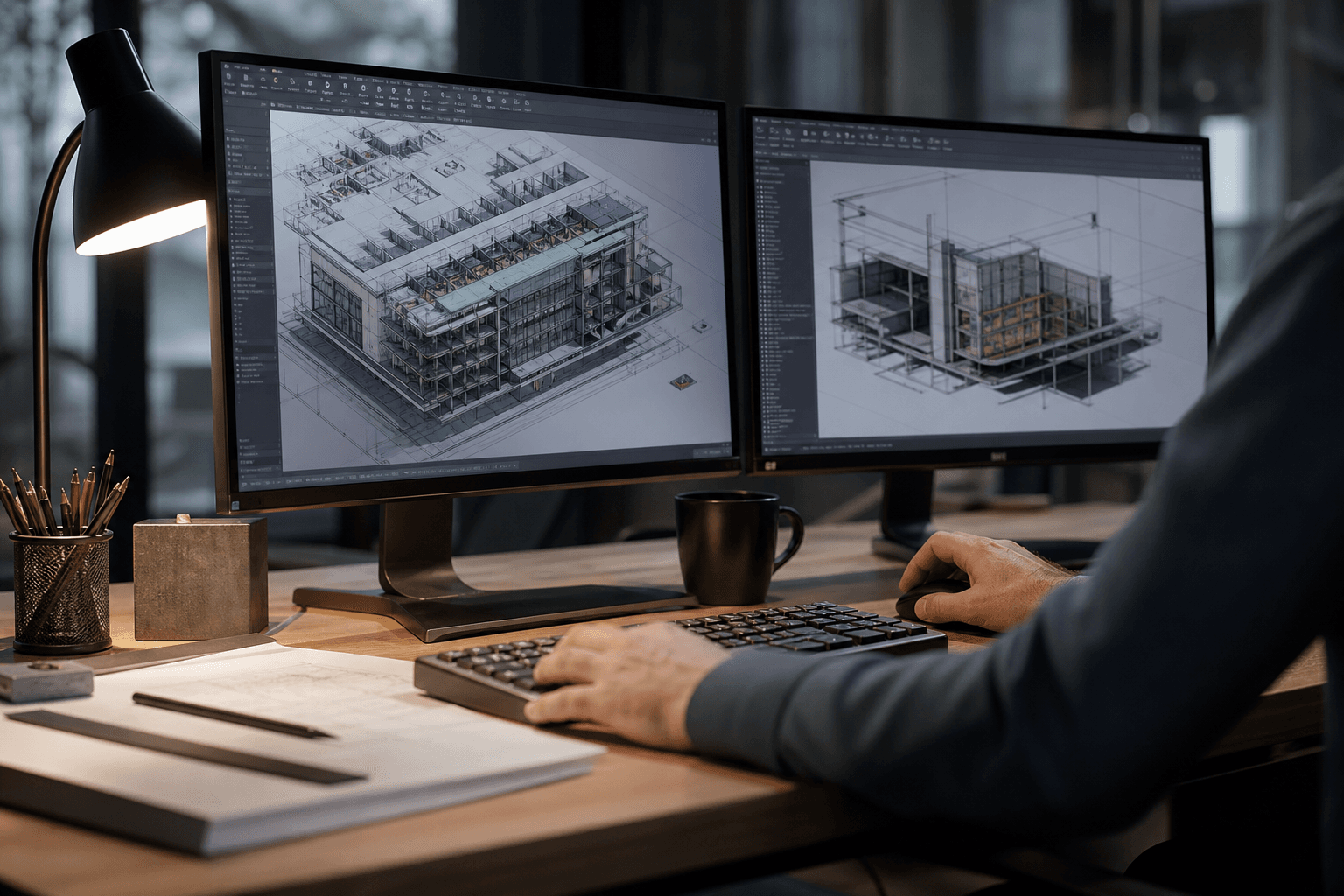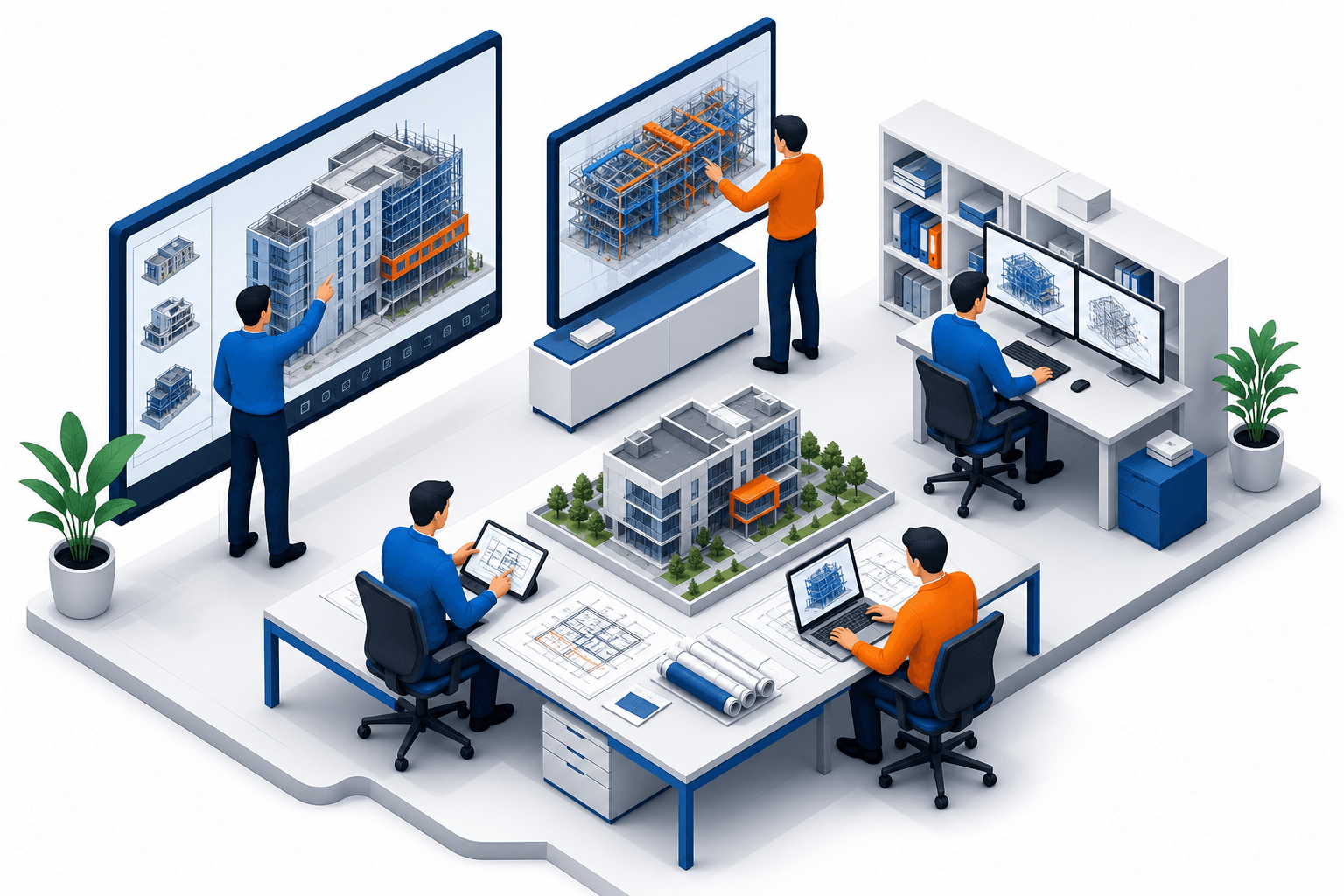
In the ever-evolving landscape of Building Information Modeling (BIM), the concept of Level of Development (LOD) has emerged as a critical standard for delineating the depth and detail of a BIM model at various stages of a project's lifecycle. As a prominent entity in the field, Adyantrix is well-versed in the nuances of LOD, ensuring that every project navigates the complexities of design, accuracy, and data integration effectively. Comprehending and implementing the appropriate LODs not only facilitates seamless communication among stakeholders but also significantly enhances the precision and predictability of BIM outcomes.
Understanding Level of Development (LOD)
The concept of LOD is central to defining how much detail and information a BIM model contains at different phases of a project. It is universally recognized and standardised within the BIM industry to streamline the complexity associated with digital construction documents. A standard LOD framework involves LOD 100, 200, 300, 350, 400, and 500, each progressively providing more detail.
LOD 100 is conceptual, focusing primarily on the project's massing, location, and the basic form of the building without detailed specifications. At this stage, elements are often represented as simple volumes or placeholders. Adyantrix utilises this foundational stage to ensure the overall project direction aligns with client expectations.
As a project progresses to LOD 200, the model begins to take shape with approximate geometry and quantified attributes necessary for basic decision-making. Elements have generic dimensions and orientations, but are not yet dimensionally precise. In this phase, Adyantrix emphasises the importance of establishing early-stage coordination to avoid costly adjustments further along the project timeline.
By LOD 300, a model becomes more data-rich, detailing the design intent with precise geometry. Elements are defined with sufficient accuracy for quantity take-offs and coordination checks. At this point, Adyantrix ensures that the dimensional accuracy and spatial coordination are thoroughly checked, which is crucial for aiding in the accurate generation of construction documentation and detailed analysis.
LOD 350 is a stage formally recognized in the AIA BIM Protocol — it adds interface and connection information beyond LOD 300, showing how elements interact with adjacent systems. This level is especially valuable for MEP coordination, where the exact geometry of hangers, sleeves, and connections is needed to detect clashes before fabrication.
Increasing the precision to LOD 400 results in fabrication-ready information, where all elements are represented as constructed, including specific assemblies and MEP (mechanical, electrical, and plumbing) details. Adyantrix partners with manufacturers and fabricators to validate these specifications before moving into production.
Finally, LOD 500 conveys the as-built model, capturing the construction reality. Adyantrix completes this stage with a comprehensive data set reflective of the completed building, useful for facilities management and ongoing operations.
The following table summarises each LOD tier across the key dimensions that matter most to project teams:
| LOD Level | Geometry Detail | Information Requirements | Typical Use Cases |
|---|---|---|---|
| LOD 100 | Massing / placeholder volumes | Area, height, location | Early feasibility, site planning, cost-per-sqft budgeting |
| LOD 200 | Approximate size, shape, orientation | Generic systems, rough quantities | Schematic design, design option comparison |
| LOD 300 | Precise geometry, accurate dimensions | Material type, manufacturer class, quantity | Construction documentation, coordination drawings |
| LOD 350 | LOD 300 + interface / connection geometry | Attachment details, sleeve sizes, support locations | MEP clash detection, trade coordination |
| LOD 400 | Fabrication-ready geometry | Specific product data, assembly sequences | Shop drawings, prefabrication, manufacturer submittals |
| LOD 500 | As-built geometry | Installed product data, serial numbers, commissioning data | Facilities management, O&M manuals, asset registers |
Setting the Right LOD at Each Project Stage
Implementing the suitable LODs at various project phases can dramatically enhance project delivery quality and efficiency. Establishing a coherent understanding of these stages involves a collaborative effort, one in which Adyantrix excels by leveraging its skilled team and robust workflow processes.
At the conceptual stage, selecting the right LOD involves understanding project scope and stakeholder requirements, a practice that is fundamental at Adyantrix to ensure client objectives are met. As the design unfolds, transitioning between LODs requires careful consideration of project demands and timelines. Adyantrix utilises dynamic modeling environments that allow for real-time updates and easy scalability of model details.
The mechanism for specifying LOD requirements is the BIM Execution Plan (BEP). A well-written BEP defines, for each model element category, the required LOD at each project milestone. For example, a BEP for a commercial office project might specify: structural steel at LOD 300 at Design Development, LOD 400 by the end of Construction Documents, and LOD 500 at project closeout. Without a clear BEP, different discipline teams may model to different levels, creating inconsistencies that only surface during coordination reviews — at exactly the wrong moment.
During the pre-construction phase, Adyantrix bridges the gap between design and actual construction through effective communication and coordination between all parties involved, thus ensuring that the BIM executions align with the precise demands of LOD specifications. By meticulously adopting the LOD 300 and LOD 400 specifications, Adyantrix enables seamless transitions into the manufacturing and construction phases.
Adyantrix's role extends into monitoring compliance with LOD requirements through the deployment of advanced BIM tools and processes, which ensures models meet the necessary standards and minimize discrepancies. Navisworks and BIM 360 Coordinate are used to aggregate discipline models and run automated clash detection reports. Any clash resolved before construction begins avoids the significantly higher cost of resolving it in the field.
Challenges in Implementing LOD
While the benefits of applying LOD in BIM projects are plenty, executing a flawless LOD strategy poses significant challenges. Adyantrix recognises these challenges and deploys bespoke solutions to mitigate them effectively.
One considerable barrier is the complexity of aligning models from various disciplines or trades, each possibly following different LOD protocols. This can result in conflicts or duplication of efforts. Adyantrix addresses this through synchronized coordination meetings and leveraging clash detection techniques to resolve discrepancies promptly. A federated model review meeting — typically weekly during the construction documents phase — is the primary forum for surfacing and resolving these issues.
Another common challenge is maintaining the model's integrity and accuracy as it transitions through different LODs, often requiring considerable upskilling and time investment. Adyantrix's commitment to continuous professional development ensures that its team is equipped with the latest BIM technologies and methodologies.
Moreover, the need for clear contractual commitments on LODs is paramount, yet often underplayed. Adyantrix aids clients in establishing legally sound documentation that defines project-specific LOD expectations upfront, reducing potential disputes later. The AIA's E203 BIM Protocol Exhibit and the associated G202 Project BIM Protocol Form are the standard vehicles for embedding LOD requirements into contracts, making them enforceable deliverable milestones rather than aspirational guidelines.
A further challenge is the temptation to over-model. Specifying LOD 400 for every element early in the design phase wastes modelling effort on elements that will change before construction. A well-calibrated BEP targets higher LODs only for elements that directly drive coordination decisions or fabrication at each milestone.
Comparison: LOD vs. Other Frameworks
To illustrate the distinguishing features of LOD relative to other frameworks, consider the following comparison table:
| Feature | Level of Development (LOD) | Stages of BIM | Stages of Design |
|---|---|---|---|
| Purpose | Specify detail levels for model elements | Define phases of BIM adoption from conceptual design to maintenance | Traditional phases like schematic design, design development |
| Phases | LOD 100, 200, 300, 350, 400, 500 | BIM Level 1, 2, 3 | SD, DD, CD |
| Focus | Detail and accuracy | Integration and collaboration | Progression and refinement |
| Usage | Ensures detailed contractual deliverables | Outlines overarching BIM adoption strategy | Guides linear design process |
Implementing LOD: A Practical Example
Below is an example of how varying LODs can be applied to a simple door:
- **LOD 100**: A door element is represented as an indicative placeholder for spatial planning.
- **LOD 200**: Dimension outlines are added, and a ground placeholder surrogate for structural investigation.
- **LOD 300**: Detailed geometry, precise dimensions, and common material information are included for accurate workup.
- **LOD 400**: Includes all material specifications, with assembly and installation instructions tailored for manufacturing.
- **LOD 500**: The model aligns with the actual as-built data including identification numbers, completion status, and operational notes.
The same principle scales to complex elements like curtain wall systems, mechanical air-handling units, or structural moment connections. At LOD 300, the curtain wall shows the mullion profile type and approximate glazing dimensions. At LOD 400, it carries specific product model numbers, mullion depths, gasket details, and the sequence of assembly — enough for the façade contractor to fabricate off-site without further RFIs. This staircased approach ensures that detailed, actionable information is constantly updated and refined, facilitating effective communication and accurate end-product delivery, just as Adyantrix achieves within its projects.
Frequently Asked Questions
Conclusion
In the vast and multifaceted field of BIM, understanding and implementing the appropriate Level of Development (LOD) at each stage of a project significantly enhances precision and successful project outcomes. At Adyantrix, we pride ourselves on our ability to navigate these complexities, offering clients meticulously managed projects from conception to completion. Our commitment to excellence ensures that every project benefits from our deep understanding of LOD, as highlighted by our BIM consulting services. If you aim to optimise your BIM processes with industry-leading expertise, we welcome you to explore the resources and guidance Adyantrix offers.